Thanks to Des Loughney from Edinburgh Trades Union Council for permission to republish this report
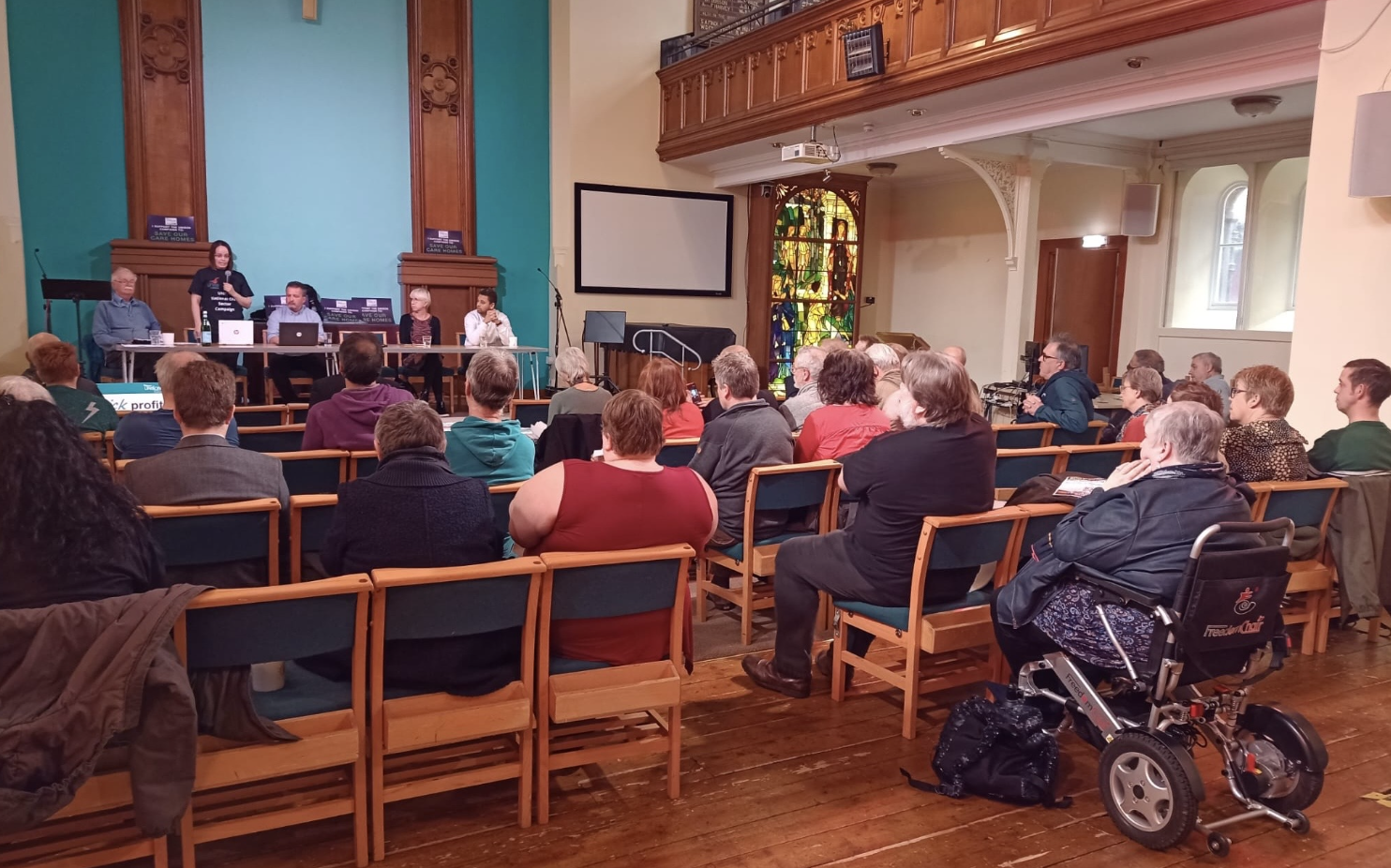
The Conference was held on Saturday 14th September 2024 between 10am and 1pm within the Augustine United Church, George IV Bridge, Edinburgh.
The Conference was organised by Edinburgh Trade Union Council. It was sponsored by the UNITE City of Edinburgh Council Branch, the UNITE Edinburgh Not For Profit Branch, the UNITE Lothian and Edinburgh Retired Members Branch, the Edinburgh branch of the EIS, and the Scottish Trades Union Congress. Sponsorship enabled Edinburgh TUC to cover all the costs of the Conference including catering and hiring the venue.
The conference was chaired by Ian Mullen, Vice Chair of Edinburgh TUC, and official of the UNISON City of Edinburgh Council Branch.
57 people registered for the Conference. A further 30 people conveyed their apologies and asked to be kept in touch with developments. The Conference was attended by four Councillors, and three MSPs (or their representatives). The attendees included trade union activists, community health activists, service users and carers.
Two briefing notes for the Conference were sent to all those who registered. One note referred to the Financial Update which was submitted to the Edinburgh Intergration Joint Board meeting on 20/8/24 and the other referred to a Report by Audit Scotland on Integration Joint Boards, Finance and Performance 2024. The Report was published in July 2024. Both notes are attached.
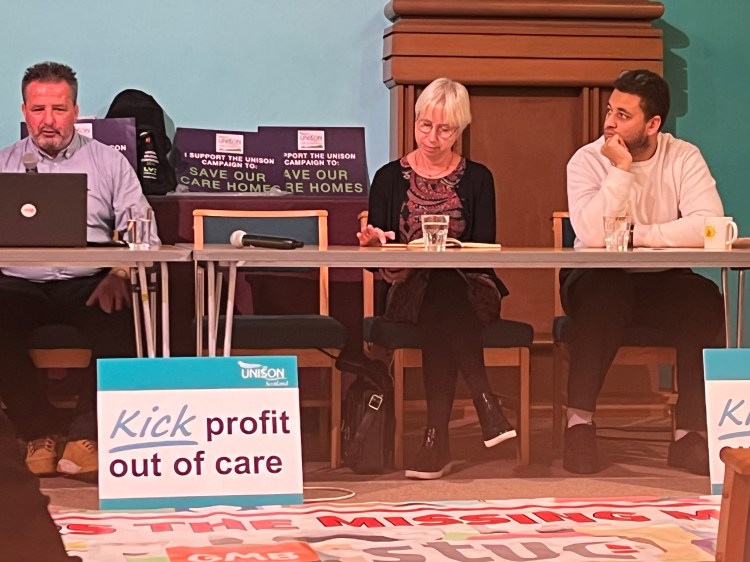
The speaker from Commonweal at the Conference was Kathy Jenkins. Her contribution is attached.
We are grateful for the reports from the workshop leader, Carmen Simon, and the notes of Ian Mackay.
The population of Edinburgh is currently growing at 1.7% per annum or 8,680 people. A fifth of the Scottish population is 65 or over.
First Session – The Impact of the Cuts
Community health projects have had their funding cut by either 10% or 20%. This had been done without proper consideration of the effective service that was being delivered by the projects or recognition of the impact on their integration with services such as those provided by Health Centres. Their preventative work is being harmed. The terms and conditions of social care workers has been worsened. Vacancies are not being filled so that work becomes more stressful. The cuts are taking advantage of low paid, vulnerable social care workers. Support for unpaid carers has been cut. Support for volunteers who assist third sector organisations has been cut.
There have been efforts to cut sleepovers to save money without appropriate consideration of the consequences for the service users. There has also not been consideration of the consequences of low paid workers losing their sleepover allowance. The wages of support workers is so low, living in a city such as Edinburgh, that some have to use foodbanks.
There has not been appropriate recognition that demand for services is not standing still but that it is increasing.
The point was made that, according to the STUC, an extra £2.5 billion could be raised in Scotland by taxing the better off. Some of that could be invested in bolstering social care. It is not true that there is no money. With the political will there could be.
After the speakers presentation there was a session of questions and contributions which reinforced the points that the speakers had made. People said that Edinburgh’s social care system is broken and dysfunctional.
Second Session – Workshops
Conference members took part in three workshops and were asked to look at three questions. 1) How do we emphasize the important of preventative work? 2) How do we measure demand for services, including increasing demand? 3) How should we campaign for more resources?
Here is an amalgamation of the workshop reports.
There was a common understanding of participants of the critical situation of social care in Edinburgh and Scotland. Some of the participants shared heartbreaking stories about the lack and /or inappropriate support that themselves or loved ones have received.
People in the workshops described the process of accessing a care package and / or not getting the care package cut by the Local Authorities as “a battle” or a “fight”
FUNDING FOR PREVENTION
Even though the Feeley report commissioned by the Scottish Government after the Covid pandemic, strongly recommended investment in prevention, this area has been neglected because there is a lack of resources. IJBs only address critical and substantial needs. Everybody in the room acknowledged that this false economy approach to social care will only exacerbate the crisis in social care
Participants agreed that language is important. We should talk about investment and not cost, we should talk about the value of social care and the cost of not investing in the sector.
People agreed that now is the time to liaise with service users, their families, and the workforce to lobby politicians and decision makers about this crisis and the need to invest in prevention services. Sarah Boyack MSP suggested the upcoming Scottish elections in 2026 as a time frame to build a coalition with stakeholders.
Some group members who work for charities highlighted the fact that they submitted plenty of data about the service they provide, the impact on people and the gaps they face in the service. They believed that it is not for lack of data that funding is not allocated to social care, but lack of political will.
SOCIAL CARE DEMAND
Everyone knows that the demand for social care will increase in the future due to people living longer and other factors such as the consequences of COVID and mental health epidemics. Measurimg exactly what the demand will be would be difficult but not impossible.
It was suggested that an exercise using proxy measurements could be done, involving public health data, university researchers and people with lived experience.
In her workshop Councillor Alys Mumford, a member of the EIJB, acknowledged that at the moment there is not a real provision for the increase in demand for social care. It was pointed out by a member of the group that the private sector will be the one stepping in to provide services. Alys agreed this would indeed most likely be the case.
Participants shared the idea that we should campaign together to stop the privatisation of social care. Some of the people agreed to be involved in a campaign going forward to make sure that the provision of social care will not only meet the basic needs of people needing support but also a provision that would enable people to thrive.
A working group considered that we ought to think about how we present the crisis in social care to the public, in seeking their support. We need to change the narrative to celebrate the good work which may be cut. We need to emphasize the resources that are required to support carers, paid and unpaid. Resources need to be allocated to empowering user groups.
Amongst the information that the public need is the performance of the private sector. What is the difference in quality between the private sector and the public sector/third sector? How much of taxpayer’s money is wasted funding the profits of the private sector? People were worried that if it is necessary to do more to meet demand the private sector will be asked to accomodate the increased demand with a low quality, cheap, service. This is because the private sector will offer cheaper services made possible by lower pay and lower staffing levels. User needs will not be put furst.
Third Session – The Way Forward: Campaigning for More Resources
Denise Christie of the Scottish Trade Union Congress reported on trade union efforts to campaign for more resources including better terms and conditions for social care workers. The programme includes training for trade union reps and the setting up of networks for sharing information and for campaigning. An objective is the lobbying of the Scottish Parliament and MSPs.
Kathy Jenkins spoke on behalf of Commonweal using information that was in the Audit Scotland Report on Integrated Joint Boards in Scotland. The Commonweal policy was that IJBs should be replaced and their function devolved to local authorities who would then further devolve to local communities. This would allow services to be truly co-designed with users/ workers and communities and to be, as far as possible, locally provided through local service hubs. Care should be ‘not for profit’ like the NHS and free at the point of need, recognising that it will take some time and a clear plan to move away from private provision. There must be good support, including support for taking sufficient breaks, for unpaid carers. The money that is wasted on private sector profit should be reallocated to support carers both paid and unpaid.
Councillor Alys Mumford who is a member of the EIJB said that more money for IJBs has to be framed as an investment that will pay ‘dividends’ in terms of the gain for the public and services users. One of the problems with IJBs is that they are responsible for the provision of services but are not able to set their budgets.
Councillor Tim Pogson said that a campaign against underfunding needs to start today celebrating good services that have been developed and need to continue to be developed. More resources needs to be made an issue in the next elections for the Scottish Parliment. These are scheduled for 2026 but could take place sooner as the SNP does not have an overall majority and may have a crisis of confidence that could lead to a general election.
There were many comments and questions from conference participants. We need to campaign to get the message across to the public that more money is needed for prevention and the parasitic role of the private sector needs to be exposed and curtailed. We need to have a strategy of using social media. We need to develop street stalls as a way of getting the issues across to the public. It was hoped that the local unions who sponsored the conference (UNITE, EIS) with the help of UNISON and the GMB will organise a programme of street stalls to get support from the public and social care workers. They could help recruit care workers to unions, particularly those care workers in the private sector.
People called on the STUC to, in the near future, organise a ‘Crisis Summit’ which may may bring the issues to public attention.
This Report is to be circulated to conference participants. It will be sent to all those who expressed an interest in the conference but could not attend. It will
be sent to Edinburgh politicians, trade unions and community organisations, including organisations of users and carers.
Edinburgh TUC will consider the feedback from the conference and how it can play a useful role in developing the campaign in Edinburgh.
Des Loughney
Secretary
Edinburgh Trade Union Council
8th October 2024
 Another Edinburgh is Possible