There was a huge amount of useful information and ideas for action shared at the meeting. These notes are an attempt to provide a concise useable summary for those who attended and all those who couldn’t make it along.
ACTION
If you weren’t at the meeting but have insights, stories or questions relating specifically to Health and Social Care or more generally to the council budget please send them in via edinburghjustrecovery@gmail.com
We noted that most people are unaware of what’s happening while carers, families and those in care are bearing the burden of a dysfunctional care system. We felt that the sub postmasters campaign shows that people will respond and agreed that it’s important to share information and stories and get them out in social and mainstream media. When we do this on the Another Edinburgh is Possible website it has an impact – please get in touch if you have stories to share or if you have friends or workmates with stories.
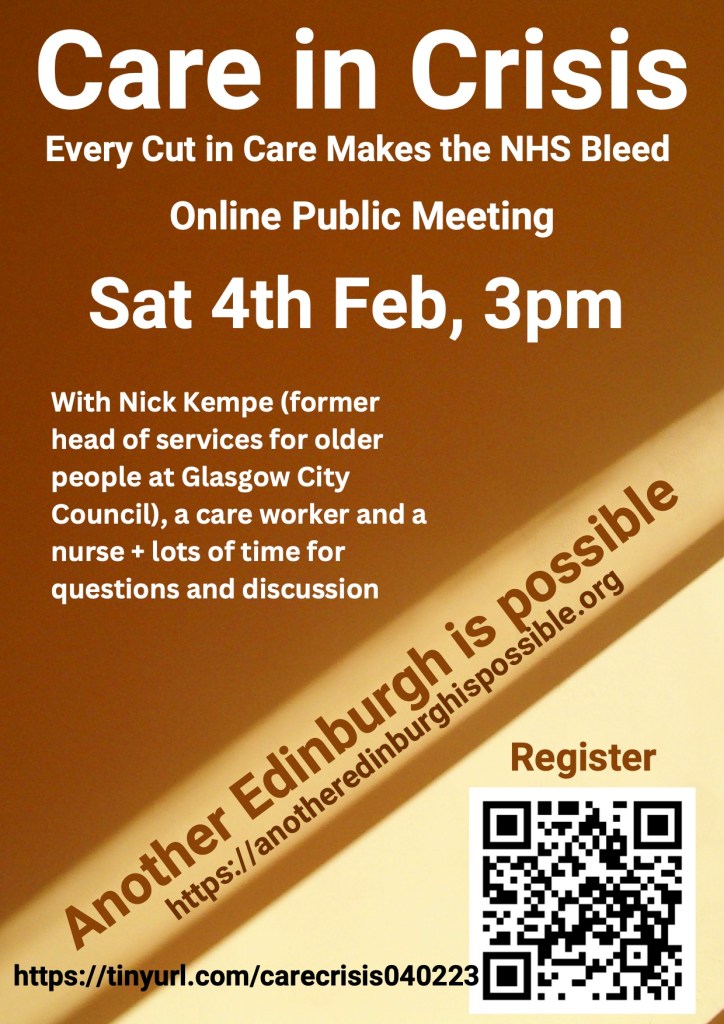
Key dates
- Friday 9th February 10am – meeting of the Edinburgh Integrated Joint Board (EIJB). It’s the EIJB that administers the Health and Social Care Partnership between Edinburgh City Council and NHS Lothian.
- Thursday 22nd February 10am – council budget setting meeting
ACTION: Please put these dates in your diary – more information on protests at these events to follow.
Council Budget
- The council meets to decide its budget on 22nd February. In the run up to it there is very little information and no debate about what areas are likely to have cuts in funding.
- Note that the budget cuts follow more than a decade of year-on-year reductions in spending on public services in the city.
- The City of Edinburgh Council financial gap for 2024 – 2025 is £ 21 million.
- For future years the estimated cumulative Council funding gaps, 2025/26 to 2028/29 are (£million) 37.5; 63.4; 93.8; 143.0.
The Health and Social Care Budget
- The Health and Social Care Partnership has a deficit of £31million.

Latest Developments in the Health and Social Care crisis in Edinburgh
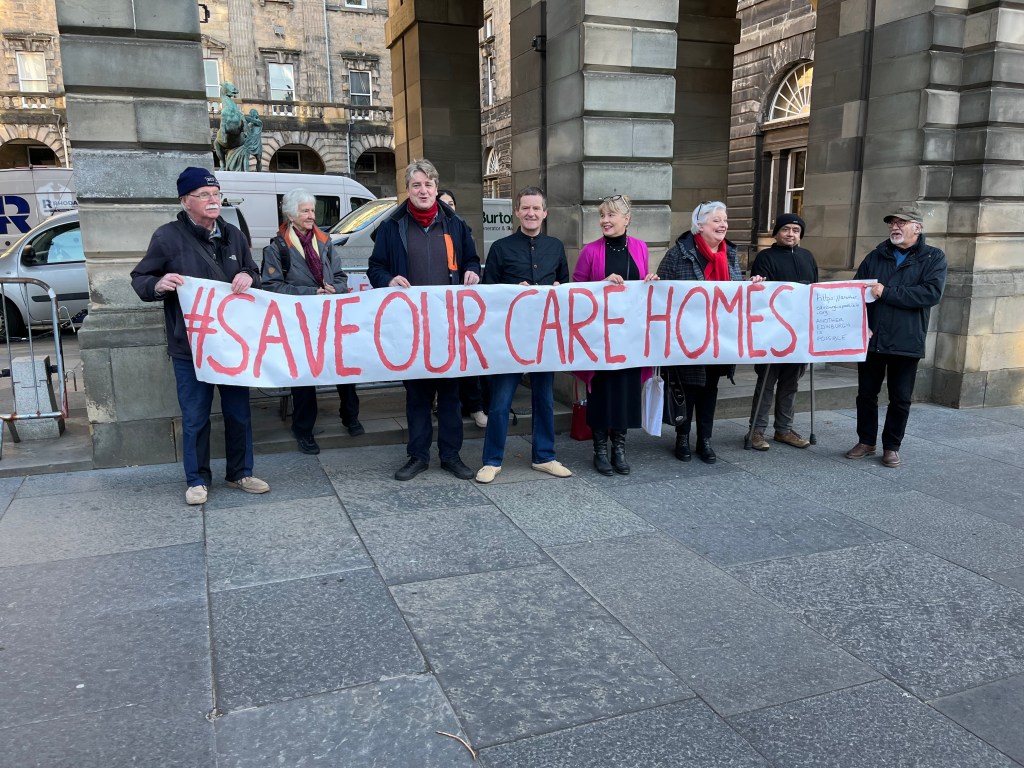
- Ross McKenzie explained that it looks likely that the bed-based review of health and social care provision seems likely to be back on the agenda again. Last time we stopped the closure of 4 care homes but failed to save Drumbrae, which now lies empty – something like £200,000 has been wasted on this. It seems likely we’ll see attempts to close at least two of the four care homes. The council run care homes are half empty – this is not because there is lack of demand – but because of failure to invest. These issues may be discussed at the EIJB on 9th February.
- There are also cuts taking place in the public provision of long-term complex care.
- Latest information on home-based care is that only 11% is publicly provided the rest is private (this includes a small amount of third sector). The council’s preference for private provision seems to be almost exclusively based on the fact that private companies pay lower wages to care staff.
- When the EIJB was in deficit in 2023 the Scottish government said that the City Council and the Lothian Health board should fill the gap. Lothian Health provided no extra money, and the Council covered the whole gap.
- Millions of pounds have been spent on hiring agency social workers to review care packages. It’s about cutting packages not reviewing them – however, the new chief officer of the EIJB has emailed councillors essentially saying that there might be push back about this process. We heard one story of how a package was cut – people are guilt tripped by being told that there are others who are worse off who need support – families face this exercise on their own and it’s hard to appeal or complain. The agency staff are doing the ‘reviews’ without having any knowledge of the individual. They come in as a one off with no understanding of what their care needs are. Despite this an email was sent around operational staff recently saying that overprovision of care didn’t help with independent living. Effectively blaming social workers for organising care packages for people who could manage with less. Or no support.
- There are staffing shortages in lots of areas, the council responds by increasing spending on recruitment rather than dealing with the root cause which is low pay and poor working conditions.
- Private care providers are recruiting large numbers of overseas care workers on sponsored visas – if sacked they must find another sponsor in 60 days or be deported and they may have paid up to £10,000 in fees to take the job in the first place. Trade Unions in Communities have been recruiting private sector care workers into unions and there is a high-profile tribunal case ongoing. BBC is working on a documentary on modern slavery in the sector.
- ATEC 24 which provides equipment for people being cared for at home is wasting large amounts of valuable equipment.
- The community alarm service is typically below half of it’s required staffing levels.
- Employers’ contributions to the pension fund have been cut. This cuts council expenditure on pensions by around £16 million and then another £3 million more for council staff who work in Social Care – council papers are very misleading on this – they talk about employees of the Health and Social Care partnership when in fact they are council employees.
- The council meeting on 22nd February is crucial. Last year at that meeting there was no mention in the budget discussions of the fact that the council might have to bail out the Edinburgh Integration Joint Board. Social care in the city is the council’s responsibility and we should insist that the council takes that responsibility and develops a plan and a budget to get the care service back on track.
- We heard serious concerns about the way in which long-term care is often delivered by the private sector. When a package of care needs to be passed on to a longer-term team 9 times out of 10 it goes to an agency. There is a lack of consistency of care. With the council you have teams that work with clients and consistency between visits. With an agency it might be a different worker for every single visit. And it might be a different set of workers. When you’re dealing with people who have dementia or Alzheimer’s consistency is important. But the long-term teams for the council are incredibly understaffed and so most of these packages of care are going out to agency now. It’s to the detriment of the quality of care being offered.
National care service
- This is back on the agenda – it seems that there is a lot of disquiet in the SNP but the plans are still to centralise control and rely on the private sector – new developments would see Justice services and children’s services under the umbrella of the NCS. Chairs of IJB’s will be appointed by the government minister. Likely to be coming up in parliament at the end of February.
What we’re fighting for
- The evidence is overwhelming that public services deliver care better. We want an end to privatisation which results low pay for workers and massive profits for company owners and shareholders. Care should be in public hands.
- There has been a long-term decline in the share of the overall Scottish budget that goes to local services this needs to be addressed.
- We want elected councillors to take responsibility for the care crisis and work to end it.
 Another Edinburgh is Possible